CPSC eFiling Is Now Live: CPC or GCC? A Clear Guide to Certificate Selection and Filing Requirements
Time: 2026-07-22 Reads: 82 Edit: Admin

CPSC new rule in effect|Certificate selection|eFiling declaration|Practical guidance for companies

July 8, 2026 — The U.S. Consumer Product Safety Commission (CPSC) mandatory eFiling rule officially took effect. For regulated consumer products imported into the United States that legally require a compliance certificate, the importer must submit certificate data through U.S. Customs and Border Protection’s (CBP) Automated Commercial Environment (ACE) system.
This change does not? add new product testing standards. Instead, it moves certificate information that used to be retained by companies and produced on demand further upstream—into the import declaration stage. Selecting the wrong certificate type, citing the wrong regulation, submitting incomplete test information, or having inconsistencies among labels, reports, certificates, and declared data can increase system warnings, risk scores, inspections, detentions, and downstream enforcement exposure.
So should a product carry a CPC or a GCC? Can a laboratory issue the certificate directly? Is eFiling just uploading a PDF certificate? This article walks through “product characterization → regulation identification → testing and certificate → electronic filing” in one pass.

Bottom line first

  • CPSC itself does not? issue any so-called “CPSC certification certificate.” Both CPC and GCC are compliance documents issued by a legally responsible party based on applicable regulations and test results.
  • “Children’s product” does not? mean every such product uses the same test package. Products primarily designed for or used by children aged 12 or younger and covered by CPSC children’s product safety rules generally follow the CPC? path.
  • “Adult or general product” does not? mean all of them need a GCC. Only general consumer products subject to a CPSC mandatory rule, ban, standard, or regulation generally require a GCC.
  • Imported products that legally require a certificate generally must use eFiling. Products manufactured in the United States are not subject to import eFiling, but must still meet the updated certificate content requirements.


01


先把CPSC、CPC与GCC的关系讲清
clarify the relationship between CPSC, CPC, and GCC

CPSC is the U.S. federal consumer-product safety regulator. It develops and enforces safety rules, conducts import risk screening, market surveillance, recalls, and enforcement. CPSC does not typically issue an “approval certificate” for a specific product, nor does obtaining a test report automatically grant official approval.
CPC(Children’s Product Certificate)applies to products primarily designed for or used by children aged 12 or younger and subject to one or more CPSC children’s product safety rules. A CPC must normally be based on tests performed by a CPSC-accepted third-party laboratory for the applicable items.
GCC(General Certificate of Conformity) applies to non-children’s general consumer products subject to relevant CPSC mandatory rules, bans, standards, or regulations. A GCC may be based on actual testing or a reasonable testing program; it does not universally require a CPSC-accepted lab unless a product-specific rule says otherwise.
A laboratory or compliance service provider can support regulation identification, testing, reporting, certificate drafting, and data review, but cannot replace the legally responsible party’s obligation to issue the certificate and own product compliance. Under the new rule, importers, U.S. manufacturers, and where applicable private-label sellers may all bear certificate obligations—determined under 16 CFR Part 1110 and product-specific rules.

Expressions to avoid

“CPSC officially issues the certificate,” “CPSC-approved product,” or “lab issues the CPSC certificate” are misleading.

● Better phrasing: the product completes applicable regulatory testing, the responsible party issues a CPC or GCC, and the certificate data is submitted as required at import.


02


CPC还是GCC???????按四步判断,, ,,, ,,,不要只看产品名称
CPC or GCC? Judge in four steps—not by product name alone
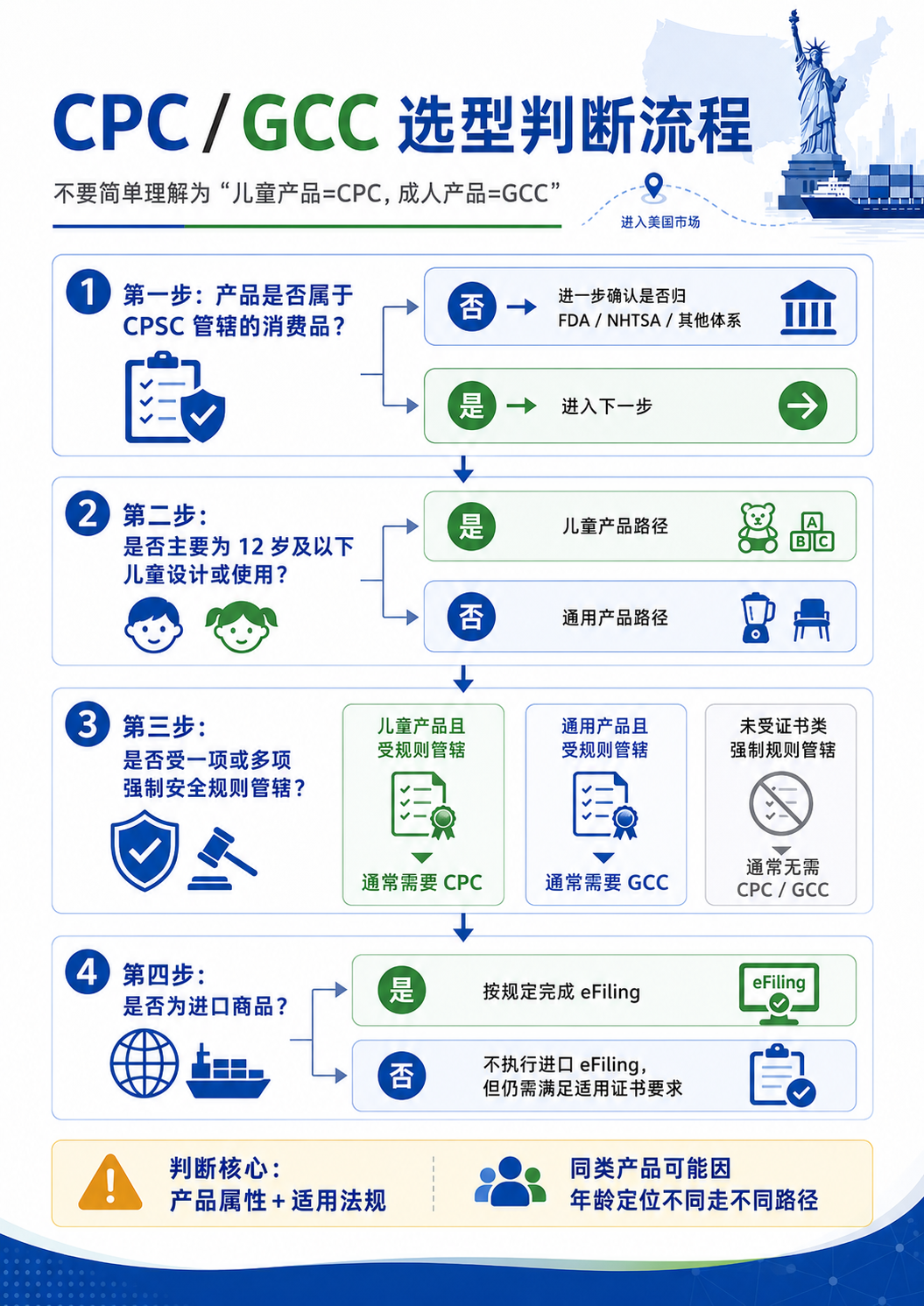
Step 1: Is the product a CPSC-jurisdictional consumer product?
Food, drugs, medical devices, and motor vehicles are mainly handled by FDA, NHTSA, etc., but that does not automatically exempt a finished product or its key components from all CPSC requirements. First confirm whether the product or its components fall under a CPSC rule, ban, or standard.
Step 2: Is it primarily designed for or used by children aged 12 or younger?
Child-directed status is not decided by the product name or a self-declared label. CPSC weighs the manufacturer’s reasonable intended-use statement, packaging and advertising, common consumer perception, and the Age Determination Guidelines. Size, function, appearance, sales channel, child models, cartoon graphics, etc. all matter—but no single factor is decisive.
Step 3: Is it subject to one or more mandatory safety rules?
  • Children’s product + children’s safety rule → usually CPC.
  • General product + applicable CPSC mandatory rule → usually GCC.
  • General product not caught by any certification-requiring mandatory rule → do not? invent a GCC just for “safety.”
Step 4: Is it an imported product?
From July 8, 2026, imported products that legally require a CPC or GCC generally must complete eFiling via CBP ACE. For goods withdrawn from a U.S. Foreign Trade Zone (FTZ) for consumption or warehousing, the effective date is January 8, 2027. U.S.-made products are not subject to import eFiling but must meet the updated certificate content rules.
非凡国际(中国区)-官方网站
(Figure 1: CPC/GCC selection flow — core is product attribute + applicable regulation; same category can split by age positioning)

03


CPC与GCC的主题差距
Core differences between CPC and GCC

Item
CPC – Children’s Product Certificate
GCC – General Certificate of Conformity
Applies to
Primarily for children ≤12 and under children’s product safety rules
Non-children’s general products under CPSC mandatory rules/bans/standards
Testing basis
Applicable third-party-tested items generally must be tested by a CPSC-accepted lab with coverage for those items
Based on testing or reasonable testing program; CPSC-accepted lab not universally required unless rule specifies
Test scope
By product category, age, material, structure, use—no fixed universal package
By product-specific rule—no fixed universal package
Issuing responsibility
Responsible legal party per regulation; lab assists but does not replace
Same
Labeling
Usually children’s product tracking label + specific warnings/exemptions
Per product rule, origin, safety warnings; no uniform children’s tracking label duty
eFiling
Required for imports that legally need a CPC
Required for imports that legally need a GCC
Reminder:? A plain ISO/IEC 17025 or CNAS report is not? automatically a CPSC-accepted lab report. For children’s products requiring third-party testing, verify the lab is on CPSC’s accepted list and that its scope covers the exact regulatory items.

04


eFiling到底扭转了什么???????
What eFiling actually changes

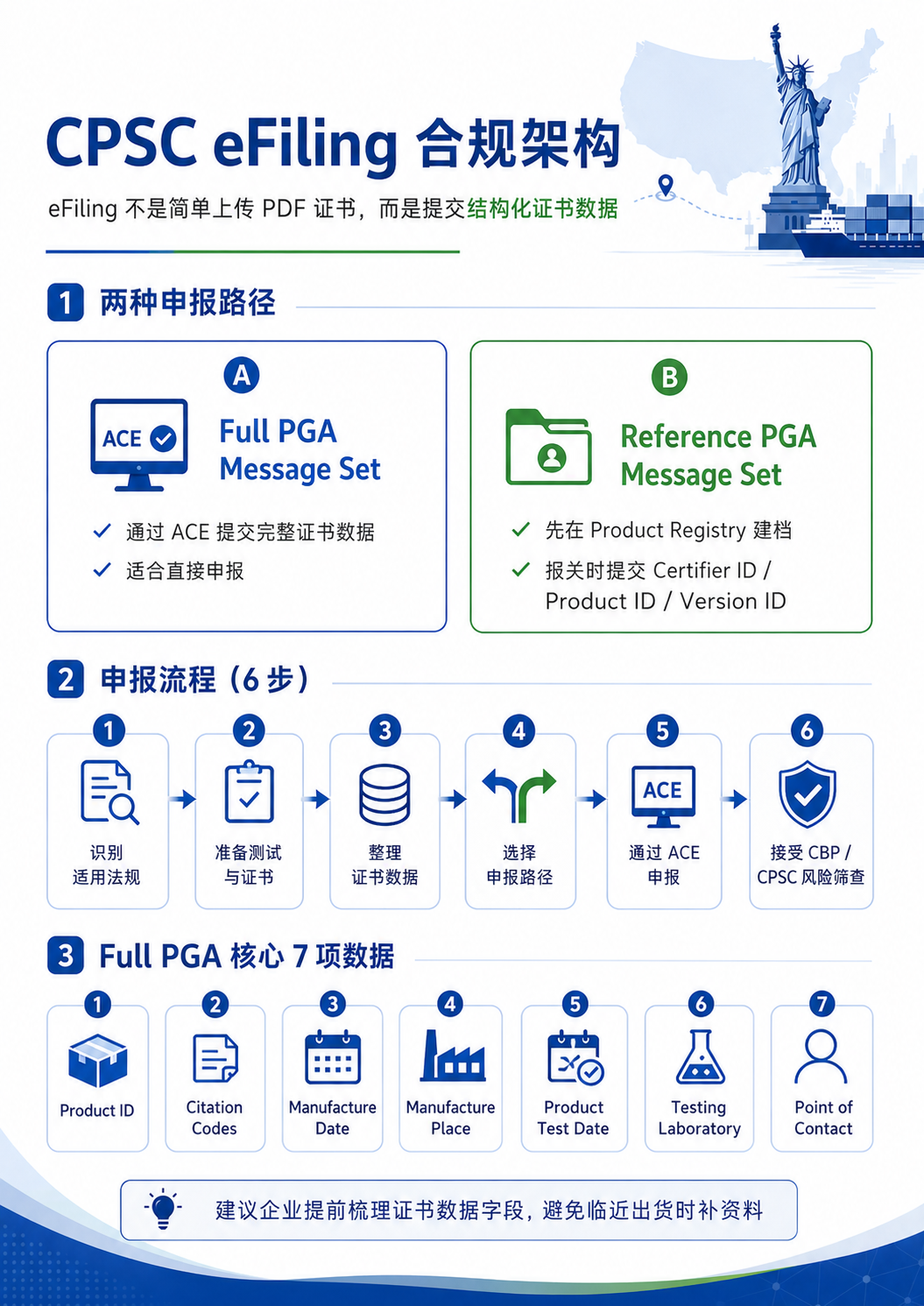
eFiling is not? uploading a PDF CPC/GCC. It is submitting key certificate data in structured form through CBP’s ACE system to CPSC for pre- and post-entry risk screening and enforcement.
两种重要申报方式Two main filing paths

A

Full PGA Message Set: Importer gives the broker seven required certificate data elements; broker submits the complete CPSC PGA message via ACE. Does not require CPSC Product Registry.

B

Reference PGA Message Set: Importer first builds and certifies product certificate data in the CPSC Product Registry, then gives the broker three identifiers at entry: Certifier ID, Product ID, Version ID. The Product Registry does not auto-sync to ACE; the broker still submits the reference message in ACE.

Full PGA Message Set的七项主题数据

1

Product IDunique product identifier (model, SKU, UPC, GTIN, etc.)

2

Citation CodesCPSC regulation codes the product complies with, accurately mapped

3

Manufacture Date: production date

4

Manufacture Place:most recent test date supporting certification

5

Product Test Date:actual lab/testing entity, matched to applicable regulation

6

Testing Laboratoryactual lab/testing entity, matched to applicable regulation

7

Point of Contact:person responsible for retaining test records and providing them

Early eFiling phase: “not rejected yet” ≠ compliant

CPSC has stated that initially it will not ask CBP to deny entry solely for missing Full/Reference PGA data; ACE may issue warnings.

● But certificate data affects risk scoring; CPSC continues to enforce certificate requirements and can seek examination, detention, seizure, or other action.

● So “the system didn’t bounce it” is not a transition-period exemption.

非凡国际(中国区)-官方网站
图2|CPSC eFiling合规架构:两种蹊径、六步流程与七项主题数据


05


哪些产品必要沉点鉴别???????
Which products need careful identification?

CPC/GCC is never decided by name alone. The same product family can split paths by target age, structure, material, size, marketing, and applicable rules.
常见CPC蹊径产品Typical CPC-path products
  • ypical CPC-path products
    Toys and some children’s activity items; cribs, play yards, pacifiers; children’s jewelry, stationery, clothing, sleepwear; other products primarily for ≤12 and under children’s rules.
    Typical GCC-path products
    Bicycles and bike helmets; mattresses, carpets, rugs; apparel flammability, lighters, bunk beds; non-children’s products with button/coin batteries under 16 CFR Part 1263, etc.
    Electronics are not automatically exempt
    “It’s an electronic product” is not a CPSC exemption. Electronics may also trigger FCC, NRTL/UL, plus CPSC questions on children’s rules, button-cell safety, flammability, packaging, etc. Different regimes do not substitute for each other.

Example: button-cell product

  • Children’s product → CPC path.
  • General product under 16 CFR Part 1263 → GCC path.
  • Same “electronic with button cell” can require different certificates by age positioning.


06


企业最容易踩中的七个误区
Seven most common mistakes

1

Judging age by product name only – ignoring size, packaging, ads, channel, consumer perception.

2

Treating children’s-product testing as a fixed menu – blindly using “total lead + phthalates + small parts + ASTM F963” may miss items or add irrelevant ones.

3

Checking lab accreditation but not CPSC scope – being on the CPSC list does not cover all children’s-item tests.

4

Citing only standard names – certificates and eFiling need accurate Citation Codes, not “ASTM F963” or “flammability test” alone.

5

Letting certificate, report, label, and physical unit drift – mismatched model, brand, manufacturer, address, dates, identifiers trigger scrutiny.

6

Treating eFiling as PDF upload – it is structured data; Reference PGA still needs three IDs in ACE.

7

Pushing all responsibility to the broker – broker submits data; product characterization, regulation ID, test basis, and certificate content must be prepared and confirmed by the company and responsible party beforehand.


07


eFiling时期,, ,,, ,,,企业应成立怎么的合规机造???????
What compliance mechanism should companies build for the eFiling era?

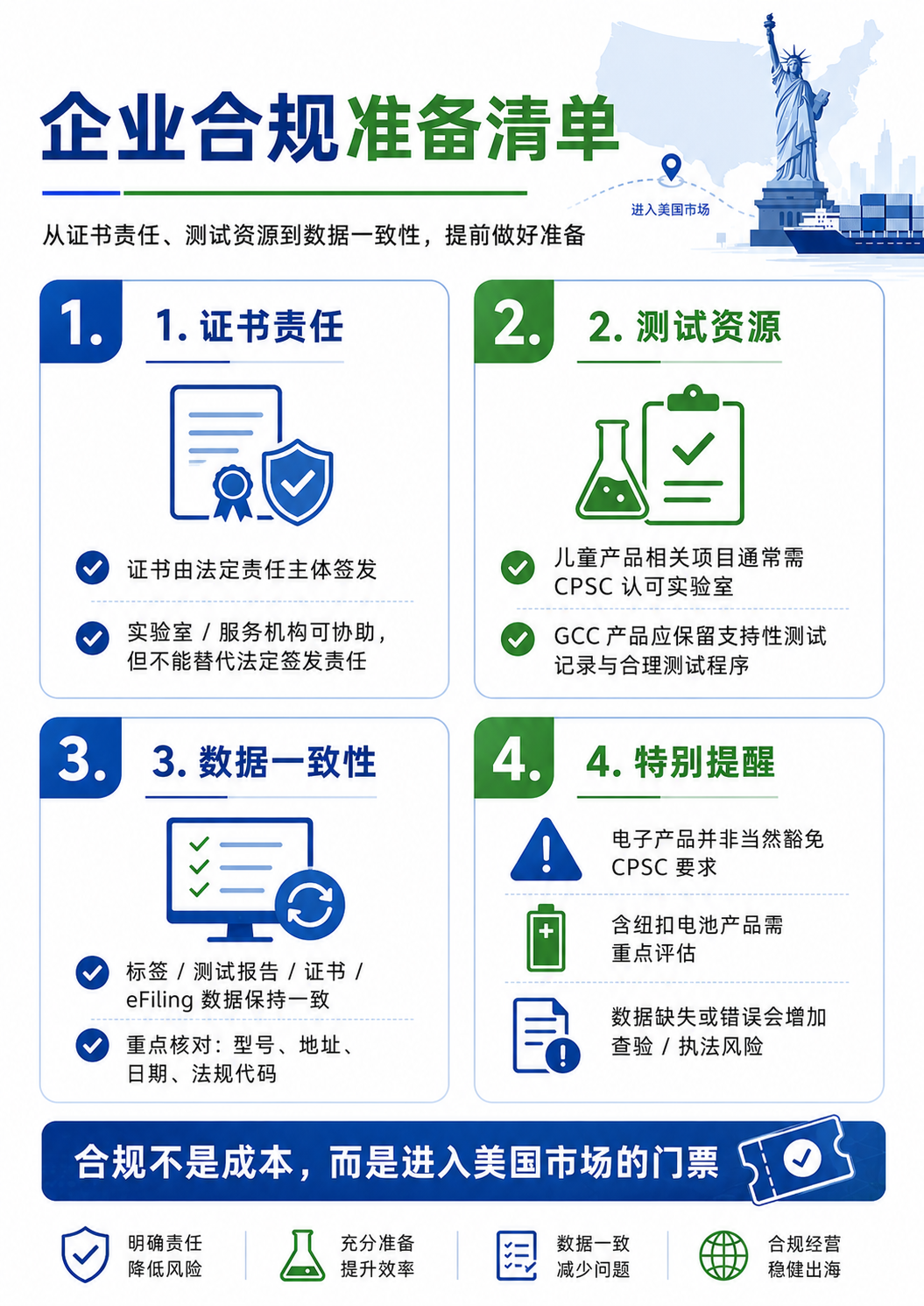
  • 1.Product-regulation determination table? – per product series: target age, use scene, material/structure, applicable rules, certificate type, test items, labeling, eFiling path; re-review on marketing/packaging change.
  • 2.Fix the certificate responsible party early? – in PO, brand license, import arrangement, broker engagement: who is the statutory certifier, who keeps test records, who feeds data to broker.
  • 3.Match testing resources to path? – CPC: verify CPSC-accepted lab and scope; GCC: build traceable test basis / reasonable program; document any exclusion, exemption, or component-test reliance.
  • 4.Build a certificate data master file? – Product ID, citation codes, manufacture date/place, test date, lab, record-keeping contact; align with ERP, orders, broker docs, Product Registry.
  • 5.“Four-way consistency” check? – physical product & label ↔ test report ↔ CPC/GCC ↔ eFiling data (brand, model, identifiers, manufacturer/importer, address, dates, regulations, lab).
  • 6.Change control? – on material, structure, supplier, software, brand, model, packaging, age positioning, or production site change: decide if retest, certificate update, Registry version bump, or declaration update is needed.
非凡国际(中国区)-官方网站
Figure 3: compliance prep checklist – responsibility, testing, data consistency, special risks

08


结语:证书只是了局,, ,,, ,,,合规系统才是主题
Closing: the certificate is the output; the compliance system is the core

CPSC eFiling pushes compliance from “keep records” to “verify data before import.” The real task is not producing one CPC/GCC, but closing the loop from product characterization, regulation ID, testing, labeling, certificate, data maintenance, to import declaration.
Earlier product-attribute and regulation-path design avoids post-tooling retests, pre-shipment label changes, unclear certificate responsibility, and repeated broker-data revisions. Compliance is not the last step before shipping—it starts at design and order confirmation.

Hongbiao Certification suggestions

● Before U.S. market entry, complete five diagnostics: product attribute + applicable regulation + certificate type + testing resource + eFiling path.

For multi-model, multi-brand, multi-importer, or recurring-shipment programs, build a standardized certificate data master and version-control mechanism.

● For case-by-case CPC/GCC calls, test plans, certificate review, or eFiling data mapping, use a professional compliance team.

 Disclaimer
This article is compiled from CPSC public rules, implementation info, and guidance available as of July 2026 for general compliance sharing. It is not legal advice, a certification conclusion, or a customs-clearance guarantee for any specific product. CPSC rules, ACE requirements, and enforcement posture may update; each product needs its own assessment by design, target age, material/structure, manufacturing model, and import setup.
Official references

CPSC|Certificates of Compliance and eFiling

CPSC|eFiling Frequently Asked Questions

CPSC|Children’s Product Certificate

CPSC|General Certificate of Conformity

CPSC|Rules Requiring Third-Party Testing and a CPC

CPSC|Rules Requiring a GCC

Federal Register|Certificates of Compliance, 90 FR 1800

— 非凡国际认证|让合规更清澈,, ,,, ,,,让出海更稳重 —

▼▼▼欢迎联系非凡国际!▼▼▼


HONGBIAO

  • Contact:0755-29989321
  • WeChat: 18098971410
  • Email: sales@sz-hongbiao.com
  • Web: www.sz-hongbiao.com
  • Address: 102, 201, Building 2, Invengo RFID Industrial Park, Tongguan Road, Tianliao Community, Yutang Street, Guangming District, Shenzhen, China